Systems used by the crypto network are regularly upgraded for efficiency and improved security purposes, as well as new additions.
While software systems can sometimes be upgraded based on the will of one firm or even one individual, the Ethereum blockchain system relies on its decentralization by allowing members of its decentralized network to assess any upgrade suggestions made.
Ethereum, the second-largest blockchain system in the crypto space, takes this approach by making it possible for upgrades to be assessed by members of the crypto community.
The system behind all the coordination is the Ethereum Improvement Proposal (EIP). The mechanism provides visibility regarding the network’s evolution and a standardized procedure for upgrading the Ethereum network. Various
Understanding the Role of EIPs
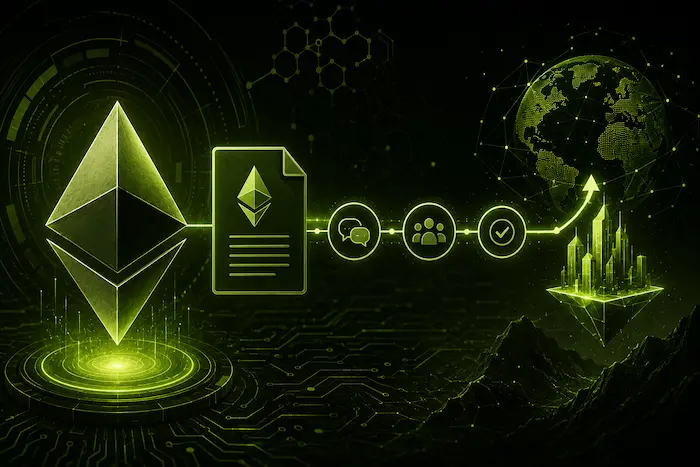
An Ethereum Improvement Proposal is a document that outlines a proposition for an upgrade to Ethereum’s functionality, along with its justification and impact.
This system was designed based on the example of BIPs (Bitcoin Improvement Proposals) in the Bitcoin ecosystem.
Some of the functions of EIPs are:
- Technical documentation of proposed changes
- Opportunity for community discussion
- Development standards
- Transparency in decision-making
- Coordination of changes in the entire network
Since Ethereum operates without any centralization, EIPs play a vital role in organizing global development.
The EIP Proposal Procedure
All proposals go through an evaluation process before they can become a part of the Ethereum protocol.
Key Phases of an EIP Proposal
| Phase | Description |
| Draft | Sample phase, where the proposal and technical information are submitted |
| Review | Members of the community review the proposal and give feedback |
| Last Call | Last chance to provide feedback before approval |
| Final | Accepted proposal ready for implementation |
Proposals can be edited, withdrawn, rejected, or superseded during the evaluation process.
Classification of Ethereum Improvement Proposals
The Ethereum platform classifies improvement proposals depending on their impact and nature.
Core EIPs
Core EIPs are those proposals that affect the functioning of the blockchain protocol in some way. This includes modifications to transactions’ processing, consensus algorithm, or any other aspect of Ethereum.
Meta-EIPs
Meta-EIPs are those that are not aimed at affecting the protocol itself but rather organizational matters.
ERC Standards
Ethereum Request for Comment (ERC) standards create standards implemented by software engineers building applications and digital assets on the Ethereum network.
Examples of important ERC standards include:
- ERC-20 for fungible tokens
- ERC-721 for non-fungible tokens (NFTs)
- ERC-1155 for multiple token types
Such specifications serve as a basis for interoperability of various Ethereum-based programs.
Governance and Involvement of the Community
Incorporating the community in the process of analyzing and adopting any network innovations is one of the major factors considered when dealing with Ethereum.
While the network relies on code, innovations related to the code undergo a process of discussion and coordination in order to be able to provide input into the decisions being made.
The importance of such an approach was evident during the DAO problem, which was faced by the Ethereum community in the earlier stages of development. After a vulnerability caused significant losses, the community held long discussions regarding finding a solution to the problem, resulting in a hard fork.
The EIP development process is still accessible to developers, researchers, and individuals. The proposals undergo evaluation via public discourse, enabling the decision of whether or not they are viable enough to advance through the approval process to become a protocol part.
Although Ethereum’s founder, Vitalik Buterin, continues to work on the EIPs, the community has a say in their approval or disapproval.
Important EIPs That Have Changed Ethereum
Several important proposals have brought about drastic change within Ethereum.
EIP-1559 and Gas Fees
This initiative was passed through the London hard fork in 2021 and altered the mechanism of gas fees in Ethereum.
Earlier, the user had to pay arbitrary fees after competing to set the gas fees.
Two main components of the EIP-1559 are:
Base Fee
- The minimum fee required for any transaction
- Automatically calculated according to the demand of the network
- Burnt forever upon payment
Priority Fee
- Voluntary additional fee that goes to validators
- Gives the user a choice of faster transaction confirmation
EIP-20
With EIP-20, the ERC-20 Token Standard became possible, allowing for the development of thousands of tokens through the Ethereum platform.
EIP-721
EIP-721 is the standard for non-fungible tokens which allows for unique digital asset creation.
EIP-4844
EIP-4844, known as Proto-Danksharding, has been introduced to increase scalability of Layer-2 networks on Ethereum through data cost reduction.
The Merge and Long-Term Development
The migration of Ethereum to proof-of-stake from proof-of-work, known as The Merge, was the consequence of the development and debates.
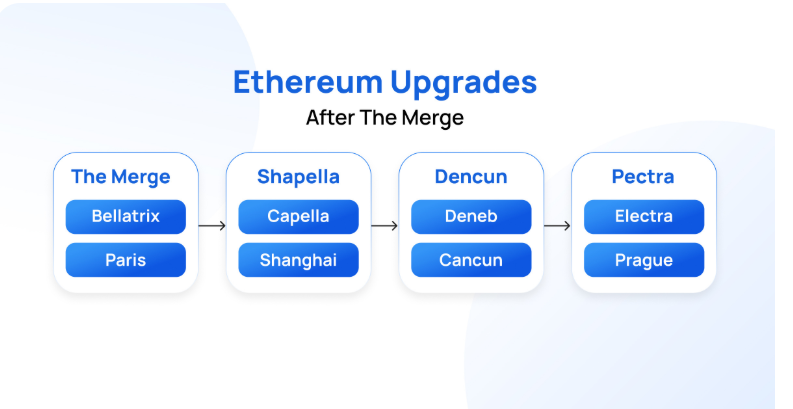
Source: Transak
The upgrade had gone through various proposals, research, and validation before implementation. The upgrade was among the most substantial developments in Ethereum and showed how EIP could be used to advance the platform.
Moreover, this was a demonstration of how consensus plays an essential role in Ethereum governance, and upgrades are always examined before implementation.
Conclusion
EIP is the system used in advancing the Ethereum network through various updates. Whether it comes to token standardization or implementing improved fee structures, EIP is the system used to achieve this.
FAQS
What is Ethereum Improvement Proposal?
Ethereum Improvement Proposal (EIP) is a formalized standard for improvements to Ethereum.
Who can make an EIP?
Anybody from a developer, researcher, and even the entire Ethereum community can make their EIP.
What is meant by EIP-1559?
By EIP-1559, we mean the implementation of the London Hard Fork in which Ethereum switched its transaction fees system by introducing burnt base fees and optional priority fees.
What is the difference between ERC-20 and ERC-721?
ERC-20 is a fungible token and hence represents interchangeable assets, but the ERC-721 is non-fungible.