

Kalshi is upping security measures on all its prediction markets following seeing over 100 possible instances of insider trading in one quarter. The new compliance requirements come on the heels of growing scrutiny from regulators and lawmakers of the fast-expanding prediction market sector.
Key Insights
- Kalshi now demands employer disclosures of traders in high risk markets.
- A new six-factor risk scoring model was introduced on the platform for new listings.
- Over the first quarter of 2026, over 100 potential insider trades were blocked.
To minimize risks associated with insider trading in its prediction markets, Kalshi has launched a new set of compliance measures. The company revealed the changes from more than 150 investigations and over 100 blocked insider trading attempts in the first quarter of 2026.
The new structure is based on the firm’s independent Surveillance Audit Committee (SAC), which was set up in February. These include such items as transparency for some traders, a risk assessment process for inclusion in the markets, and new tools for traders to be able to report on.
New controls target higher-risk markets
The latest rules apply to markets that carry a greater risk of insider trading or manipulation. These may include contracts linked to corporate performance, national security developments, and major geopolitical events.
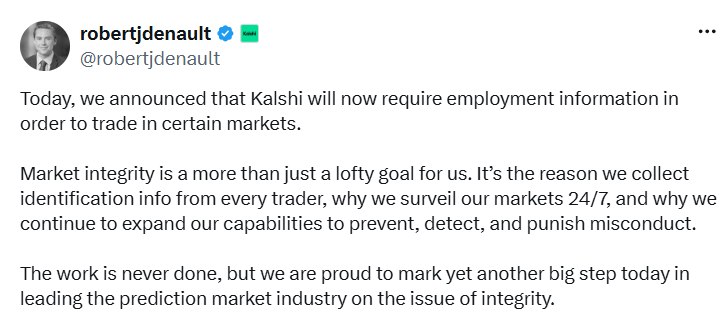
Under the new policy, traders who meet specific thresholds must provide information about their employers before participating in designated markets. The company said the information will not be routinely reviewed unless an investigation is opened.
The disclosure process is designed to help identify potential insiders before trades occur. Certain users may also face restrictions from participating in specific contracts based on their professional roles.
In addition, the platform introduced enhanced reporting channels that allow users to submit concerns directly to a surveillance team operating around the clock.
Risk assessment becomes part of market listings
Every proposed market will now undergo a structured review before launch. The assessment assigns a risk score based on six factors linked to market integrity and manipulation concerns.
The framework evaluates
- Corporate performance and event-related risks
- Outcome concentration risks
- Market significance
- Regulatory considerations
- Non-traditional insider risks
- National security concerns
Markets considered vulnerable to manipulation may face additional restrictions. Some contracts may not be listed if the associated risks outweigh their potential benefits.
Robert DeNault, the company’s head of enforcement, said national security reviews were added to identify concerns before markets become available for trading.
The company stated that these reviews can help prevent situations where sensitive events influence markets or where markets create unintended risks.
Growing scrutiny across prediction markets
The announcement arrives as prediction markets face increased attention from regulators and law enforcement agencies.
Several recent cases have raised concerns about insider trading within the sector. In April, United States prosecutors charged a special forces soldier accused of using non-public information to place trades on prediction contracts tied to the capture of former Venezuelan President Nicolás Maduro.
A month later, authorities charged a software engineer at Google for allegedly using confidential company information to trade prediction contracts connected to search engine outcomes.
The sector has also attracted congressional attention. In May, House Oversight Committee Chairman James Comer requested information from major prediction market operators regarding their monitoring and enforcement practices.
The company previously disclosed disciplinary actions against political candidates who traded on contracts involving their own campaigns. It also referred former Congressman George Santos to authorities following trading activity connected to a contract about attendance at a presidential address.
Expansion continues alongside compliance efforts
Kalshi still continues to grow its business while beefing up enforcement efforts.
Recently, the company was seeking new product areas such as perpetual futures contracts with cryptocurrencies. It has also gone further into digital asset trading by further listing of crypto-related products.
Meanwhile, the Better Business Bureau’s National Advertising Division filed a complaint with the regulators after the company refused to participate in a review of disclosures for influencer advertising.
Although there is more regulatory focus on prediction markets, they are still used by a lot of people. Over the last twelve months, trading volume has gone up significantly in the industry, following the rising popularity of event-based contracts in political, financial and global matters.
Conclusion
This is part of a larger effort by Kalshi to tighten up its compliance program amid the rising scale and popularity of prediction markets. Disclosures by employers, risk scoring and greater surveillance tools represent a more proactive attitude towards protecting market integrity.
The effectiveness of these measures will likely continue to be closely watched by regulators, lawmakers and market participants, as investigations proliferate through the industry. Going forward, the Surveillance Audit Committee’s reports might be the first signs of the effectiveness of the new protections in lowering risks associated with insider trading on the platform.