
XRP is a cryptocurrency that operates on the XRP Ledger blockchain which is an open-source blockchain network developed with the purpose of carrying out cheap and fast cross-border transactions.
XRP has, since its launch in 2012, grown to be one of the leading market cap cryptocurrencies while operating as a payment cryptocurrency rather than a store of value, like most other blockchains.
The XRP Ledger is independent of Ripple, although Ripple uses the XRP for some payment applications. Throughout the years, XRP has evolved due to various technical developments, litigation cases, and increasing attention to investment instruments.
XRP for Cross-Border Payments
The XRP Ledger was founded by Jed McCaleb, Arthur Britto, and David Schwartz, who initiated the project back in 2011. Their main aim was to develop a blockchain platform, which would be able to process cross-border payments faster compared to ordinary payment systems. The XRP ledger was launched in 2012 together with the Ripple Network.
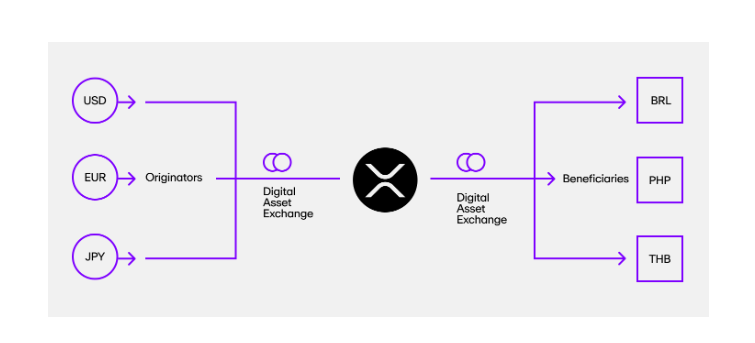
Source: Moonpay
Unlike Bitcoin, the currency that was created for transactions and keeping money as a decentralized currency, XRP is specifically made for cross-border payments.
The cryptocurrency is called a bridge currency since it allows financial institutions to exchange their currencies for XRP and then change to another currency in just a few seconds.
How XRP Uses an Alternative Consensus Algorithm
The XRP ledger uses the Ripple consensus protocol to validate transactions instead of using proof of work or proof of stake.
In this system, the validators keep a list of trusted peers called the Unique Node List (UNL). The validators put forward a set of transactions, compare it to the others and finalize them once an 80% consensus is reached. In this way, the blockchain achieves consensus without mining while being Byzantine fault-tolerant.
The mechanism of consensus also ensures that there can be no competing blockchain histories since the honest validators come to the same state before making the transactions final.
According to Ripple, XRP transactions take three to five seconds to confirm; transaction fees are negligible and amount to just a fraction of a cent; and the network can handle up to 1,500 transactions per second.
Due to the absence of mining, the energy consumption in the ledger is much lower compared to proof-of-work ledgers.
XRP Ledger in Brief
| Feature | Information |
| Year of Launch | 2012 |
| Consensus Mechanism | Ripple Consensus Protocol |
| Transaction Speed | 3–5 seconds |
| Transactions per Second | Around 1,500 transactions per second |
| Transaction Fee | Fraction of a cent |
| Mining Requirement | No |
Timeline of Development and Regulation
The history of XRP goes further back than just the inception of the XRP Ledger. Ryan Fugger had already invented Ripplepay in 2004, prior to McCaleb, Britto, and Schwartz designing a new digital currency system that would be derived from Bitcoin in 2011.
Chris Larsen and McCaleb merged their initiative with Fugger’s invention to form OpenCoin in September 2012. In 2013, the organization renamed itself as Ripple Labs, which again changed its name to Ripple in 2015.
Brad Garlinghouse became Ripple’s CEO in December 2016, and the XRPL Foundation was founded in September 2020 to aid blockchain development.
Among the major events was the SEC’s filing of a lawsuit against Ripple in December 2020, stating that the company carried out unregistered securities offerings by selling $1.3 billion worth of XRP tokens.
On July 7, 2023, U.S. District Judge Analisa Torres concluded that the XRP token itself does not constitute a security in the case of its retail purchase via digital asset exchanges.
Although the sale of such assets in the institutional market constitutes an unregistered securities offering. In 2024, Ripple paid a civil penalty of $125 million.
The case persisted until 2025 before being resolved. In March 2025, Ripple made it known that the SEC would be withdrawing its appeal, subject to approval by the Commission.
By August 2025, both sides had withdrawn their appeals, and Ripple had also settled the civil penalties it owed as well as the injunction on the sale of institutional XRP.
Major Regulatory Events
- SEC lawsuit filed in December 2020.
- Partial court ruling issued in July 2023.
- Appeals withdrawn by both parties in August 2025.
XRP Adoption and Investment Products
The XRP Ledger supports more than payment transfers. In addition to serving as an alternative to Bitcoin for settling transactions, developers have found the following uses of the network for token creation, decentralized trading, decentralized finance applications, stablecoins, tokenization of physical assets, and other blockchain financial applications.
All that makes the network go far beyond payment systems while preserving XRP as its native cryptocurrency. XRP can be obtained through cryptocurrency exchanges such as Coinbase, Binance.US, and Crypto.com in the USA.
The storage of XRP can be conducted in hardware wallets like Ledger and Trezor and in software wallets such as Trust Wallet, Exodus, Edge, and Atomic Wallet.
XRP investments in regulated financial instruments have gained popularity too. In October 2024, the company Bitwise filed a registration form for an XRP spot exchange-traded fund, while 21Shares, WisdomTree, and Grayscale filed their own separate forms of the same.
In March 2025, Bitnomial launched CFTC-regulated XRP futures contracts as another XRP-related instrument regulated by authorities.
XRP Investment Examples
- Spot XRP ETF filing of multiple asset management companies.
- CFTC-regulated XRP futures by Bitnomial.
- Continued access via popular cryptocurrency exchanges.
Conclusion
With its payment-oriented technology, different consensus system, and ongoing regulations, XRP is still a digital currency with the main objective being cross-border payments. The technology behind it, the legal background, and various financial instruments make up its place in the blockchain ecosystem.
FAQs
What is XRP?
It is a native cryptocurrency of XRP Ledger and it is designed for rapid and cheap cross-border transactions.
How is the process of transaction validation conducted in the XRP Ledger?
Transaction validation in the XRP Ledger is done through Ripple Consensus Protocol and it means that mining and staking is not required as independent validators come to consensus.
Are XRP and Ripple the same thing?
No, they are not. The name Ripple refers to the company itself whereas XRP is the native crypto asset of the XRP Ledger.
What is the outcome of the lawsuit filed by the SEC against Ripple?
Both parties withdrew their respective appeals in August 2025. SEC received $125 million civil penalty payment from Ripple and permanent injunction on institutional sales of XRP.