

The financial markets are not static after their official trading sessions end. Developments such as the release of company earnings and economic data that take place outside the trading periods are capable of influencing investors’ expectations even before the next trading period starts.
Such occurrences have opened doors for pre-market trading in both conventional markets and also the cryptocurrency market prior to the listing of a new coin. Pre-market trading is the name given to these early trade activities, although the process varies from one asset class to another.
In the equity market, the process occurs prior to the opening of exchanges like the NYSE or Nasdaq, whereas in the crypto market it normally entails trading of tokens before their listing or distribution.
However, while both systems facilitate participation in the markets prior to more extensive participation, they do so using different trading and settlement procedures.
What is Pre-Market Trading?
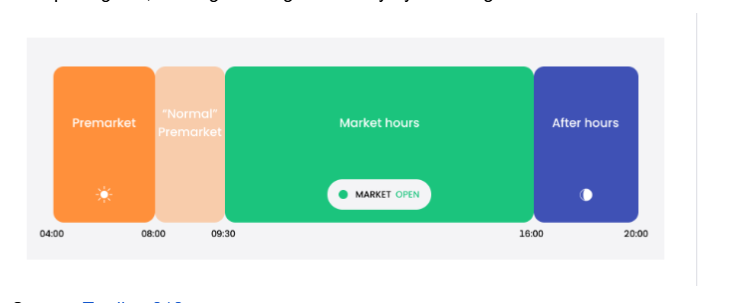
Pre-market trading means trading transactions that take place prior to the opening of an actual market session. In the United States, the normal trading session at NYSE and Nasdaq takes place between 9:30 am and 4:00 pm Eastern Time.
Pre-market sessions generally begin as early as 4:00 a.m. ET and continue until the opening bell, although trading hours vary by brokerage.
Source: Trading 212
Not every listed stock is available during the pre-market session. Trading in pre-market occurs less than regular market trading because there are fewer buyers and sellers involved.
In crypto markets, pre-market trading occurs when an allocation for a certain token is announced, but the token is not yet listed on the exchanges. There are also some platforms that allow trading of points within protocols, which may entitle users to certain tokens or airdrops.
How Pre-Market Trading Works
Pre-market trading through the use of Electronic Communication Networks (ECN) is done in an electronic manner, whereby the buyer and seller reach an agreement on the trading price.
Determinants of Pre-Market Trading
Corporate Releases
Quarterly earnings announcements that take place after the end of the previous market session and prior to the start of the following market session.
Economic and Regulatory Events
Economic data, monetary policy actions, regulation information, M&A activity, and geopolitical events may influence the market prior to the start of the normal session.
Token Launch Events
In the crypto space, IEO (Initial Exchange Offerings), TGE (Token Generation Event), and allocation announcements are known to impact pricing ahead of listings.
The crypto pre-market trading process differs from that of stock trading. In crypto pre-market trading, both buyers and sellers determine the value of the token prior to its launch, while the settlement process occurs after the token’s release. Some of the centralized exchanges support this form of transaction by serving as the custodian of the assets until all settlement criteria are met.
Why Investors Trade in the Pre-Market
Investors observe the pre-market trading process to gain from information made available outside of trading hours. This includes corporate earnings, inflation figures, employment statistics, central bank statements, product launches, and regulation.
The pre-market session gives participants an early indication of the sentiments prevailing in the market. Although these prices are not indicative of the price that the asset will trade at for the rest of the session, they provide some clues about how participants have responded to the new information.
When it comes to cryptocurrencies, the pre-market session provides participants with an opportunity to set a price for the token prior to it being publicly traded.
Difference Between Pre-Market and Regular Market Trading
The primary distinction between pre-market trading and conventional market trading is that of the market’s participants. With regular trading, there are institutional investors, market makers, and individual traders offering greater liquidity and more efficient price discovery.
The pre-market period has less activity due to fewer participants, meaning lower volume levels and increased spreads. In conventional markets, trading takes place prior to the opening of exchanges via ECNs. Cryptocurrency markets trade with regard to token distribution prior to exchanges opening.
Conclusion
Premarket trading gives market participants the opportunity to trade before opening official market sessions or token listing starts. In conventional financial markets, it enables investors to react to events overnight through the Electronic Communication Network before the exchanges open.
In cryptocurrency markets, it provides the buyer and seller with an opportunity to make agreements on token prices before making a public listing, with settlement made after the listing.
FAQs
What is pre-market trading?
Pre-market trading is the trade of financial instruments before the opening of a stock market.
When does pre-market trading begin in the USA?
As for US stock markets, the pre-market opening is set for 4:00 a.m. ET and ends when the main market session opens at 9:30 a.m. ET. Hours of pre-market trading may vary depending on a particular broker.
What is crypto pre-market trading?
Crypto pre-market trading provides an opportunity for traders to come to an agreement on the token’s price before its listing. Settlement usually takes place after the token is listed and distributed.