

Stablecoins are designed to maintain a value close to a reference asset, most commonly the U.S. dollar, but the mechanisms supporting that target differ across major projects.
As of August 2026, USDT and USDC remain the two largest dollar stablecoins, with approximately $183 billion and $72 billion in market capitalization, respectively, according to CoinGecko.
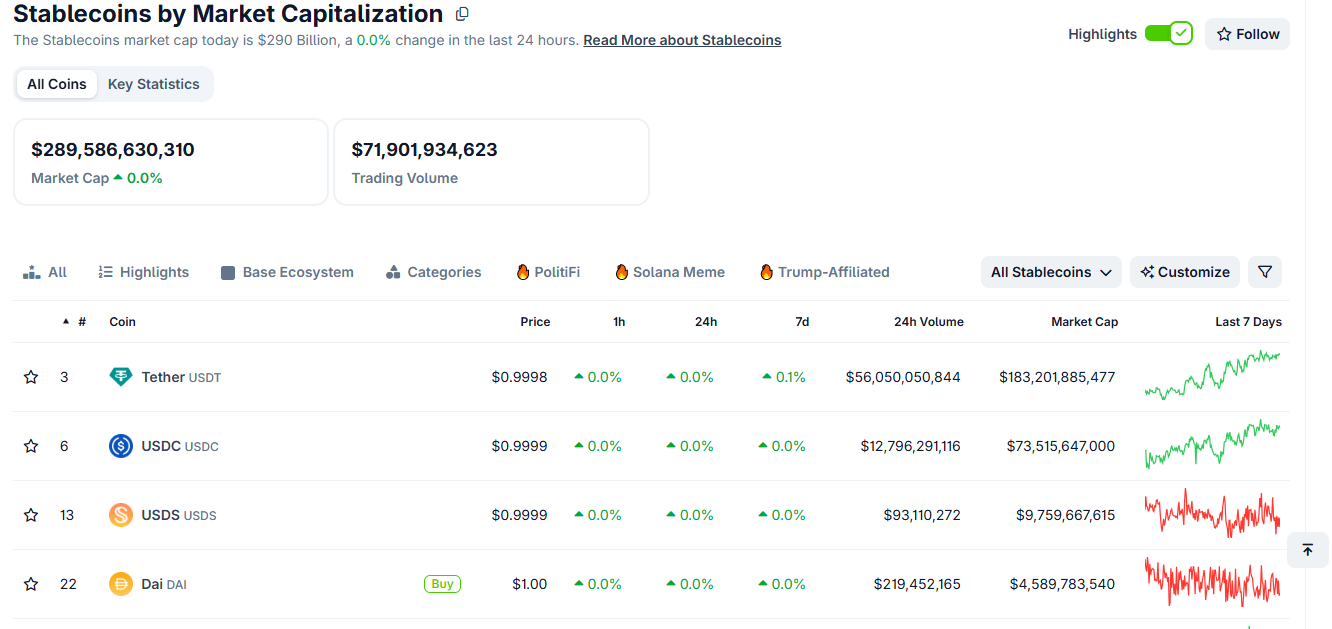
Source: CoinGecko
Reserve-backed models rely on collateral, redemption, and market activity, while decentralized and algorithmic designs use different structures. At the same time, U.S. regulatory requirements are placing greater emphasis on reserves, redemption procedures, disclosures, and risk controls.
How Stablecoins Maintain Their Dollar Peg
A $1 target does not guarantee that a stablecoin will always trade at exactly $1. The peg depends on collateral, redemption mechanisms, liquidity, issuer credibility, and arbitrage.
For reserve-backed stablecoins, an eligible customer can provide $1 to an issuer and receive one token. When the token is redeemed, the issuer removes it from circulation and returns the corresponding dollar value under applicable rules and fees.
Secondary-market activity can reinforce the peg when traders buy discounted tokens and redeem them or create and sell tokens when prices move above $1.
Three factors are central to the mechanism:
- Reserve quality and liquidity affect an issuer’s ability to meet redemptions.
- Redemption access determines who can exchange tokens directly with the issuer.
- Market liquidity and arbitrage can influence temporary price deviations.
Stablecoins USDT and USDC Use Different Reserve Structures
USDT remains the largest dollar stablecoin. CoinGecko recently recorded its market capitalization at about $183 billion and its market price at approximately $0.9992.
Tether reported that USDT issuance reached about $184.6 billion in its July 31, 2026, second-quarter update, alongside a $4.11 billion excess reserve buffer. The company also reported $1.5 billion in net operating profit for the quarter.
Tether’s disclosed reserve strategy includes significant exposure to liquid assets such as U.S. Treasuries. Its February 2026 information document states that verified customers can redeem Tether tokens for their face value in the applicable fiat currency, subject to eligibility requirements, a $100,000 minimum redemption amount and fees.
USDC has a separate reserve structure. Circle states that every USDC is backed by an equivalent amount of U.S.-dollar-denominated assets and that reserves are held separately from Circle’s operating funds for the benefit of USDC holders.
Circle publishes reserve information weekly and says a Big Four accounting firm provides monthly third-party assurance. As of August 20, 2026, Circle reported approximately $72.7 billion of USDC in circulation.
| Feature | USDT | USDC |
| Issuer | Tether | Circle |
| Approx. market cap | $183B | $72B |
| Peg model | Reserve-backed | Reserve-backed |
| Reserve reporting | Periodic independent attestations | Weekly disclosure and monthly assurance |
| Direct redemption | Eligible verified customers | Eligible institutions through Circle Mint |
The figures are based on CoinGecko data available in August 2026, while reserve and redemption details come from the respective issuers.
Crypto Collateral Creates a Different Risk Structure
USDS represents an overcollateralized model that uses crypto-native collateral and smart contracts. Sky describes USDS as backed by collateral that can include stablecoins, on-chain lending positions, and short-duration Treasury-bill exposure.
Overcollateralization provides a buffer because more than $1 of collateral can support $1 of issued stablecoins. Smart contracts can liquidate positions when collateral ratios fall below specified thresholds.
This structure shifts some risks from centralized reserves toward collateral volatility, liquidity, smart contracts, and oracles.
Algorithmic Models Carry Different Depeg Risks
Algorithmic stablecoins use supply adjustments, incentives, arbitrage or relationships with other tokens rather than relying entirely on conventional reserves. TerraUSD, or UST, used its relationship with LUNA to target $1.
When UST traded below the target, the system theoretically allowed exchanges for $1 worth of LUNA. The mechanism depended on confidence in LUNA and sufficient market demand.
In May 2022, UST lost its peg, and the Terraform ecosystem collapsed. The SEC said UST and related tokens fell close to zero and that more than $40 billion in market value was wiped out.
Regulation Adds Reserve and Redemption Requirements
The GENIUS Act became law on July 18, 2025, establishing a federal framework for payment stablecoins.
Permitted issuers must maintain qualifying reserves on at least a one-to-one basis, with eligible assets including U.S. dollars, certain deposits, short-term Treasury securities and specified Treasury-backed instruments.
The law also establishes requirements covering redemption, disclosures, supervision and financial-crime controls. As of August 2026, the final implementing rules had not triggered the earlier 120-day effective-date provision, leaving January 18, 2027, as the statutory backstop.
FAQs
Why can a stablecoin trade below $1?
Market liquidity, redemption access, reserve concerns and arbitrage conditions can cause temporary deviations from the target.
Are USDT and USDC backed the same way?
Both are reserve-backed, but their reserve disclosures, corporate structures, redemption arrangements and infrastructure differ.
Can reserve-backed stablecoins lose their peg?
Yes. The March 2023 USDC episode showed how banking uncertainty can cause a reserve-backed stablecoin to trade below its $1 target.
What does the GENIUS Act require?
The framework requires permitted payment stablecoin issuers to maintain qualifying reserves on at least a one-to-one basis and establishes redemption and disclosure requirements.