
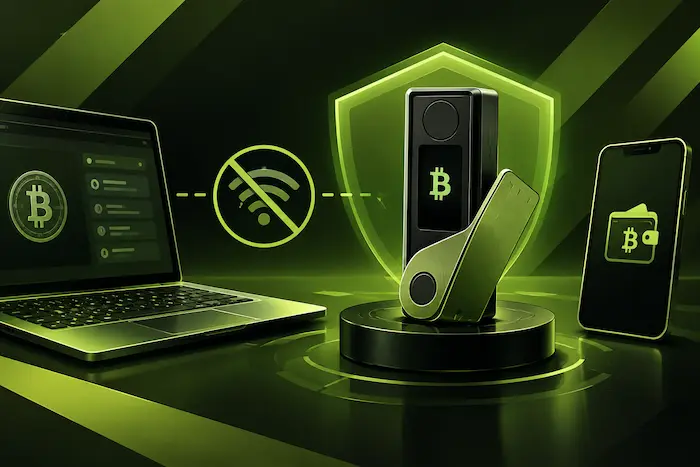
An air-gapped wallet allows for offline signing of blockchain transactions that do not require any internet connection since the private keys remain offline. This practice has been enjoying resurgence in 2026 because of personal wallet hacks and fears of hardware wallet vulnerabilities.
Instead of holding cryptocurrencies, the wallet safeguards the private keys or signatures that will allow the transactions to take place through the blockchain network. The assets will continue to be registered in the blockchains but will rely on the security of the signature of those assets.
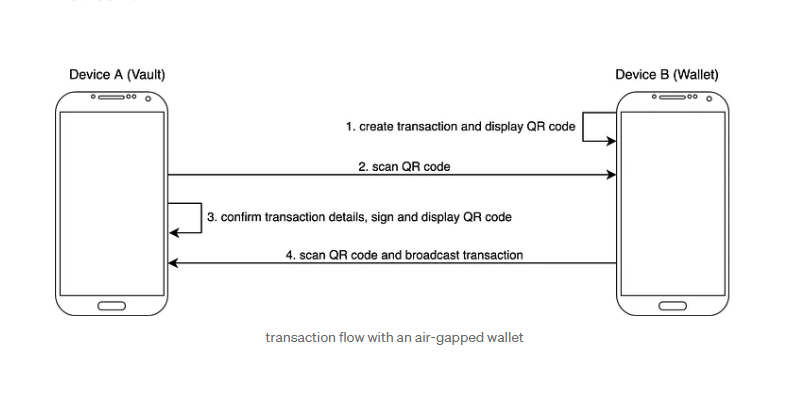
An air-gapped system involves using an online computer or smartphone to draft and disseminate transactions and an air-gapped one to sign them. Data can move between the two environments through QR codes, microSD cards or other controlled methods without directly connecting the signing device to the internet.
How an Air-Gapped Wallet Separates Transaction Signing
The security model centers on keeping the signing device disconnected from network connections when private keys are used. The connected device prepares an unsigned transaction and transfers the required information to the offline wallet.
The isolated wallet proceeds to sign the transaction on its own, after which the transaction can be sent back to the connected device, which subsequently broadcasts the transaction to the respective blockchain network.
Air gap feature of Keystone disables the USB and Bluetooth features and uses QR codes to transmit the information. Its documentation also describes offline private-key storage and QR-based transaction workflows.
Source: Medium
Other devices can use different transfer methods, including microSD cards. The key characteristic is therefore the separation between the private-key environment and the internet-connected environment rather than the specific transfer technology.
| Feature | Air-gapped setup | Conventional hardware wallet |
| Private keys | Kept offline | Kept offline |
| Internet connection during signing | Separated | Device-dependent |
| Data transfer | QR codes or controlled storage | USB, Bluetooth or other interfaces |
| Transaction verification | On the isolated device | On the hardware device |
Air-Gapped Wallets Reduce Remote Attack Exposure
An air-gapped wallet can limit the ability of malware on a connected phone or computer to directly reach private keys. This separation is particularly relevant when the online environment is used to interact with potentially compromised software.
However, isolation does not automatically make every transaction safe. A compromised connected device could alter transaction information before it reaches the signing wallet.
The user must therefore verify the destination address, amount, network, and other transaction details on the wallet before approving the transaction.
Ledger describes a similar security principle by keeping private keys inside a Secure Element and signing transactions on the device. Trezor also states that its hardware wallets keep private keys offline and allow transaction review before signing.
The distinction between these products and fully air-gapped systems is important. A hardware wallet can provide offline key storage without maintaining the same degree of physical separation from connected devices.
Communication between Ledger and other connected devices is possible via interfaces such as USB and Bluetooth, among others, depending on the specific Ledger device used.
Private-Key Theft is a Serious Security Risk
Some figures on cryptocurrency thefts from 2024 shed light on why there has been much focus on private-key security. According to Chainalysis, more than $2.2 billion worth of cryptocurrency has been stolen within 2024, which involves a case of private key theft, representing 43.8% of stolen cryptocurrency.
Chainalysis has further reported over $3.4 billion in cryptocurrency theft in the following year, 2025. In its report, Chainalysis reported that there were 158,000 cases of personal wallet compromises involving at least 80,000 different victims in which $713 million was lost.
However, the figures cannot conclude that all the owners of cryptocurrency require an air-gapped wallet.
Physical security has also become relevant. According to the report by Chainalysis issued in August 2026, violent acts against owners of cryptocurrencies have resulted in the loss of approximately $30 million worth of cryptocurrencies in the first six months of the year, following $58 million in the previous year, 2025.
An Air Gap Cannot Prevent All Risks
The security benefits of an air-gapped wallet depend on how the entire custody process is managed. A stolen recovery phrase can undermine the protection provided by an isolated signing deA recovered password to the wallet will expose the user’s privacy, as it will allow the wallet to be created at another location using the same recovery password.
Other risks include malicious firmware, supply chain compromise, manipulated transactions, and phishing attacks. Academic research has also examined unconventional methods for extracting information from compromised air-gapped systems, showing that physical isolation is a risk-reduction measure rather than an absolute security guarantee.
Transaction verification remains particularly important. An isolated wallet can protect a private key while still allowing a user to approve a malicious transaction. The trusted display on the signing device therefore serves as an important checkpoint before authorization.
For users holding assets for longer periods, an air-gapped wallet can provide stronger separation from online environments. However, the additional scanning, verification, and backup procedures also increase operational complexity.
Conclusion
An air-gapped wallet uses physical and network separation to keep private keys away from internet-connected environments during transaction signing.
The design may help minimize remote exposure while having users confirm transactions and handle their recovery phrases safely. The efficiency of the design will finally depend on the security of the whole custody process and not just air-gapping.
FAQs
What is an air-gapped wallet?
Air-gapped wallets are crypto wallets designed to keep private keys isolated from online devices when transactions are signed.
How is an air-gapped wallet used for transactions?
Air-gapped wallets may use controlled ways of transferring unsigned and signed transactions via QR-codes or micro SD cards.
Is an air-gapped wallet completely safe?
Not always. It solves some problems; however, it does not solve all the possible dangers, including phishing, attacks on the device using malware or firmware, or transaction approval on an offline basis.