

Key Takeaways
- Crypto exchanges are increasingly getting into the act by freezing suspect assets and providing intelligence to law enforcement.
- Scam investigations are becoming more of a multi-national effort, with agencies and technology firms working in multiple countries.
- Infrastructure disruption is now a primary strategy, targeting accounts, servers, connectivity, and financial flows simultaneously.
Coinbase has frozen more than $3 million in cryptocurrency linked to fraud networks operating across Southeast Asia. The action formed part of a coordinated international campaign led by the U.S. U.S. Attorney’s Office specializing in online scams, criminal infrastructure, and financial venues to defraud victims.
The operation occurred during Disruption Week, which is a DOJ’s Scam Center Strike Force initiative. Government agencies, technology companies, and law enforcement partners worked together to disrupt cyber-enabled investment fraud schemes that have caused billions of dollars in losses.
Global effort targets fraud networks
The coordinated action brought together major private and public organizations. Participants included Meta, Microsoft, Starlink, the FBI, the U.S. Secret Service, and international law enforcement agencies from Thailand, the United Kingdom, Australia, Canada, and New Zealand.
Authorities focused on networks connected to investment fraud and pig butchering scams. Often these schemes lure victims to invest larger sums of money via deceptive online relationships and fake investment schemes.
The operation is said to have impacted over 1.4 million social media and email accounts associated with criminal activities. It also targeted servers and hosting infrastructure of fraud groups.
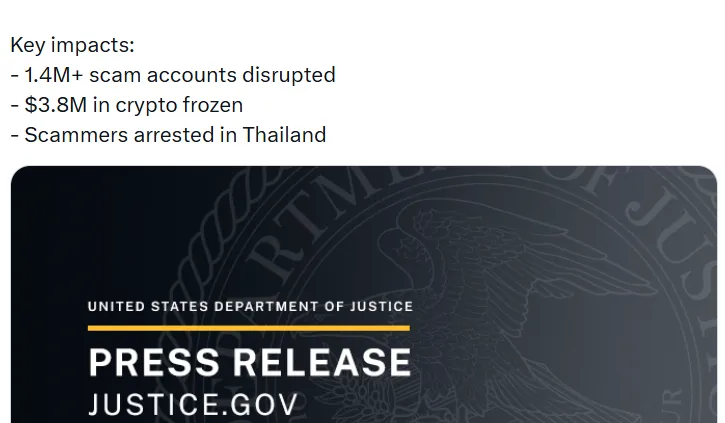
The police, Royal Thai Police, made arrests related to the investigation. As investigators ramped up their investigations into scams in the area, several suspects were arrested.
How private companies played a part in the action
Coinbase’s role was to be a financial intelligence agency and freeze any digital assets associated with the scam networks. The company provided data to partners, in order to ensure monitoring of financial crime and enforcement.
The sharing of intelligence between businesses aided in recognizing online accounts, infrastructure and potential scam locations, according to Meta. Microsoft also deactivated thousands of accounts that it suspected were associated with fraud.
Starlink also cut off service connections related to illegal activities. This was the joint effort to break the fraud networks at different points instead of just one.
Key outcomes from the operation included
- More than $3 million in cryptocurrency frozen
- Over 1.4 million online accounts disrupted
- Multiple arrests by Thai authorities
- Hosting infrastructure and communication channels disabled
The DOJ described the campaign as an example of how cooperation between industries and governments can strengthen fraud prevention efforts.
Blockchain tracking remains central to investigations
Coinbase stated that blockchain technology provides investigators with a transparent record of transactions. The company argued that public ledgers can help authorities follow financial trails connected to criminal operations.
The exchange said scammers cannot be effectively challenged by one organization acting alone. It emphasized that social media platforms, financial institutions, internet providers, and law enforcement agencies all played critical roles.
Federal authorities continue to highlight crypto investment fraud as one of the most damaging threats facing consumers. The FBI recently reported that losses tied to crypto-related and AI-related scams exceeded $11 billion in 2025, with investment fraud accounting for a significant share.
Wider enforcement pressure builds worldwide
The latest operation follows several major enforcement actions carried out this year. In April, authorities associated with the Scam Center Strike Force froze more than $701 million in cryptocurrency connected to investment fraud schemes.
That earlier action also targeted hundreds of fraudulent investment websites. Investigators said many of those platforms displayed fake account balances and fabricated returns to encourage additional deposits.
International authorities have also increased pressure on scam compounds and fraud centers.
The impact on fraud networks and enforcement outcomes
The coordinated action has a profound impact on financial and digital infrastructure commonly exploited in fraud schemes, thereby affecting scam networks. The implementation of freezing of crypto assets makes it more difficult to move money for criminals and decreases the liquidity of crypto asset funds. Meanwhile, the blocking of social media and email accounts of more than 1.4 million users also reduces contact and manipulation methods available for scammers to continue to deploy so-called scale operations in investment and pig butchering frauds, across regions.
This effect is felt also in the enforcement capabilities and platform security systems. The technology industry’s intelligence can be leveraged by law enforcement to detect patterns of fraud and enhance cross-border investigations. By shutting down hosting services and connectivity tools, this also adds to the pressure on scam networks, requiring re-building of networks again and again and increasing the expense of their ongoing operations.
Conclusion
Coinbase remains part of a broader coalition working to disrupt online fraud and crypto-enabled scams. The latest operation combined financial intelligence, technology platform enforcement, and law enforcement action across several countries. Coordinated action is becoming a major strategy in containing financial losses and crippling criminal infrastructure as authorities around the world apply increasing pressure on scam networ