

The choice of crypto trading platforms in September 2026 should not be determined by the number of available assets or fees. The current state of exchanges indicates large differences in spot volumes, market presence, derivatives trading, liquidity, and transparency.
CoinMarketCap currently tracks 242 spot exchanges, while CoinGecko monitors 163 exchanges using factors that include liquidity, cybersecurity, and operational scale.
The latest figures also show that exchange rankings can vary by data provider. Binance leads the group in reported spot activity, while OKX, Bybit, MEXC, Gate, KuCoin, and other venues post different combinations of volume and asset coverage. Coinbase and Upbit also maintain significant positions in their respective markets.
Binance leads current spot volume
Binance remains the largest exchange by the reported spot figures supplied for this comparison. CoinMarketCap recorded about $10.9 billion in 24-hour spot volume, while CoinGecko reported more than $10.3 billion.
The exchange supports spot markets as well as perpetual contracts and futures. It also publishes proof-of-reserves information intended to help users verify whether account balances are backed by corresponding assets.
Binance’s availability and product range can differ by jurisdiction. As a result, geographic access and regulatory restrictions remain relevant when comparing the platform with other global exchanges.
How crypto trading platforms compare on volume?
The current data places several exchanges within a much narrower volume range than Binance. OKX had a daily spot volume in excess of $2.1 billion, according to CoinMarketCap, and $1.93 billion, according to CoinGecko.
Bybit posted approximately $1.7 billion in CoinMarketCap’s spot data. KuCoin reported about $1.48 billion, while HTX recorded about $1.03 billion.
MEXC and Gate were also close in reported activity, with approximately $1.75 billion and $1.73 billion in 24-hour spot volume, respectively, on CoinMarketCap. These figures show why exchange-wide volume can provide only one part of a comparison.
| Exchange | 24-hour Spot Volume | Market coverage or feature |
| Binance | Approximately $10.9B CMC; $10.3B+ CoinGecko | Spot, perpetuals, and futures |
| OKX | Approximately $2.1B+ CMC; about $1.93B CoinGecko | Spot, derivatives, and Web3 |
| Bybit | About $1.7B | Derivatives and copy trading |
| MEXC | About $1.75B | 1,600+ coins and 2,800+ markets |
| Gate | Approximately $1.73B | 1,700+ coins and 2,500 markets |
| KuCoin | About $1.48B | 1,600+ coins and 1,000+ markets |
| Upbit | $1.3B+ | Strong KRW market activity |
| HTX | About $1.03B | Nearly 800 coins and 900+ markets |
| Coinbase | About $1.75B CoinGecko | 500+ trading pairs |
Asset coverage separates major crypto trading platforms.
MEXC and Gate stand out for the size of their listed markets. CoinMarketCap also shows over 1,600 coins with more than 2,800 markets at MEXC. In turn, Gate lists more than 1,700 coins and about 2,500 markets.
Similarly, KuCoin has complete market coverage with over 1,600 coins and 1,000 markets. This creates access to assets that may not be available on more selective venues, while also making individual-market liquidity an important consideration.
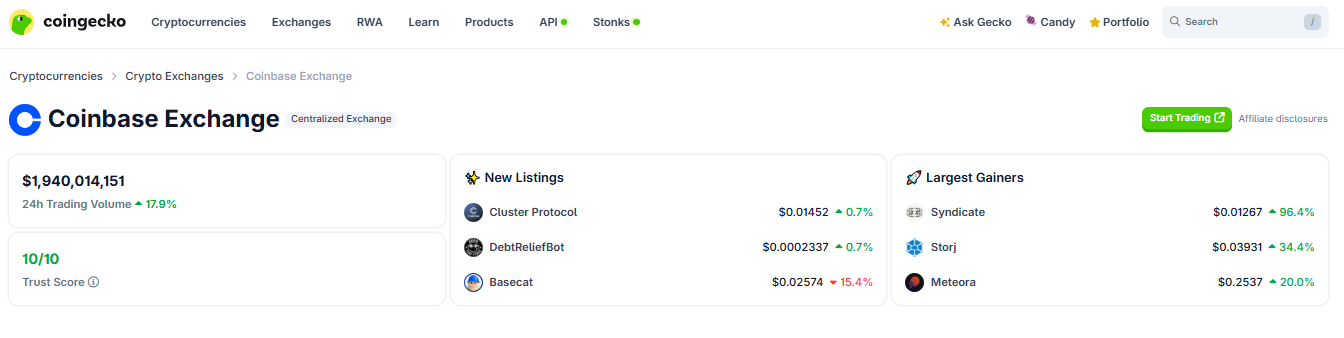
In contrast, Coinbase is unique in that it has hundreds of coins and over 500 trading pairs. Based on CoinGecko, the exchange makes a daily trading volume of $1.75 billion in crypto and has gotten a 10/10 Trust Score.
Source: CoinGecko
Korean-won markets support the activity of Upbit to a large extent. The spot volume of the 24 hours in CoinMarketCap now exceeds $1.3 billion, which shows that the liquidity in the region has a significant impact on the rankings of exchanges on a global scale.
Transparency and product risks continue to be significant.
Multiple crypto trading sites that are part of the comparison provide proof-of-reserves information. In August 2026, OKX issued a report that listed the primary assets at $22.96 billion with reserve and liability files for verification.
In July 2026, Bybit added an additional 50 tokens to its PoR reporting. It has released a report that it has independently verified by Hacken, which indicates that major assets such as BTC, ETH, USDT, and USDC have ratios above 100%.
According to the Bitget August 2026 Report, the total ratio of reserves reached 122%, and the users can report monthly and check the reserves using Merkle Trees. The exchange includes the spot markets, derivatives, and copy trading.
These products can involve different forms of trading risk. Bybit has substantial derivatives activity, while Bitget offers both derivatives and copy trading. Users therefore need to understand the mechanics and applicable limits of the products available to them.
What the September data shows?
The current exchange figures demonstrate that crypto trading platforms differ substantially in market structure and reported activity.
Binance has the largest spot volume in the supplied data, while OKX, Bybit, MEXC, Gate, Coinbase, Upbit, KuCoin, HTX, and Bitget occupy different positions based on volume, regional activity, market coverage, and product offerings.
CoinGecko’s methodology also demonstrates why volume should not be viewed in isolation. Its exchange assessment considers liquidity, cybersecurity, and operational scale alongside trading activity.
For investors trying to compare crypto trading platforms, the September 2026 data set, therefore, offers several factors that can be measured, such as volume reported, market-by-market liquidity, listing of assets, reserves reporting, and jurisdictions.
Conclusion
The September 2026 data set suggests an exchange market environment that is highly fragmented, with crypto trading platforms competing on factors such as volume, listing of assets, derivatives, liquidity, and transparency.
The Binance platform stands out in the reported spot volume figures, while others excel in some other aspects.
FAQs
Which crypto trading platform has the highest reported spot volume?
Binance is the largest volume spot trading platform with $10.9 billion as of 11 September 2026, according to Coinmarketcap.
What does proof of reserves show?
Proof-of-reserves reporting provides information intended to help users verify exchange-held assets and corresponding reserves.
Why do exchange rankings differ between data providers?
The datasets and methodology for calculating the trading volume by both CoinMarketCap and CoinGecko are different.