

The adoption of smart contract auditing tools has become vital in 2026 due to the intricacy of the DeFi code and its upgrades. Trail of Bits, Cyfrin, a16z, Certora, and other security developers have expanded capabilities spanning static analysis, fuzzing, symbolic execution, and formal verification.
The need for these tools is reflected in recent incident data. According to Immunefi, in April 2026, DeFi protocol loss amounts were reported at $680 million for 2025 against $534 million in 2024.
Nonetheless, the average loss per attack was lower from $6 million in 2022 to $1.5 million in 2025. The DeFiLlama hack database still registers cases with access control, oracle manipulation, accounting issues, and protocol logic.
Methods Used by Smart Contract Auditing Tools for Security
The security tools analyze the contract using various methods. Static analysis is the analysis of source code and control flows, while fuzzing is an analysis of input and transaction flows looking for anomalies.
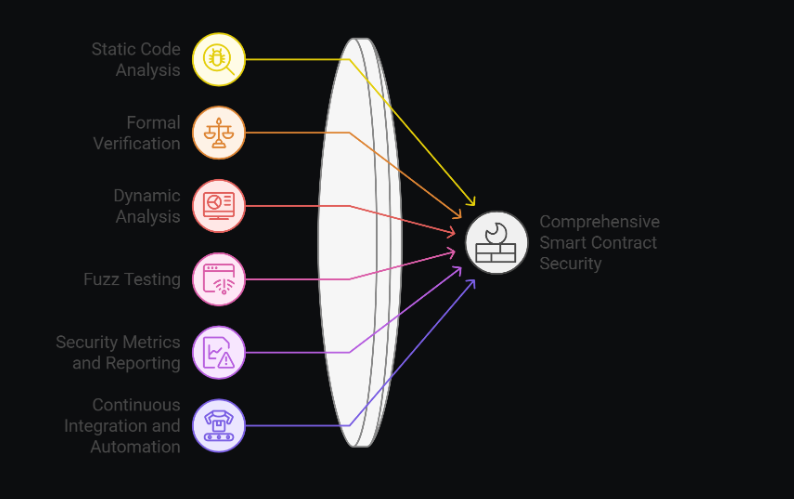
Source: Rapid Innovation
Symbolic execution is the analysis of the states of the program based on the constraints, while formal verification is the analysis of the properties of the specified system in the modeled execution environment.
The reason is that vulnerabilities may exist at various levels. For instance, a static analysis tool can find a suspicious external call, while a fuzzer may detect a transaction path that breaks an invariant. Formal verification allows assessing whether the defined property holds in the entire execution space.
In July 2026, The Block reported that there were also persistent doubts regarding the ability of the AI and automation tools to substitute the role of security experts, especially if vulnerabilities are dependent on some real-world conditions.
Slither and Foundry provide core development security capabilities.
Slither, developed by Trail of Bits, remains a leading static analysis framework for Solidity and Vyper. It provides vulnerability detectors, contract-structure information, and an API for custom analyses. Its capabilities include upgradeability reviews, ERC compliance checks, storage analysis, and property generation.
Foundry takes a broader development approach. Its Forge environment supports building, testing, fuzzing, debugging, and deployment, while Anvil provides a local blockchain environment.
Foundry’s v1.8.0 release introduced an opt-in preview of native symbolic testing and mutation testing, alongside further fuzzing and invariant-testing improvements. Forge Lint also includes security and gas detectors.
Echidna, another Trail of Bits project, specializes in property-based fuzzing. It generates contract-call sequences and tests developer-defined properties or invariants. The tool supports corpus collection, mutation, and coverage guidance while minimizing failing cases to make discovered problems easier to reproduce.
Aderyn, developed by Cyfrin, provides another static-analysis option for Solidity projects. Written in Rust, it supports Foundry and Hardhat projects and can produce Markdown, JSON, and SARIF reports. Its integrations include VS Code and GitHub Actions. Its GitHub repository lists version 0.6.8 as a January 2026 release.
Formal verification and symbolic execution add deeper checks.
Certora Prover occupies a different category from conventional scanners because it focuses on formal verification. The developers describe the expected behavior of contracts through Certora Verification Language, and the Prover applies an SMT solver to see if these rules can be broken.
When a rule is disproved, the system can provide a concrete test case demonstrating the violation.
Halmos, developed by a16z, extends Foundry-oriented development through symbolic testing for EVM smart contracts. Instead of assigning only random values to inputs, symbolic testing represents inputs as variables and reasons about multiple possible values. a16z documentation includes examples where symbolic testing identified a counterexample that conventional fuzzing did not find.
Medusa provides another fuzzing approach within the Crytic security tooling ecosystem. The Go-based fuzzer supports parallel fuzzing, property testing, mutation-based input generation, and coverage-guided campaigns.
However, it stores coverage-increasing call sequences in a corpus and mutates them to explore additional behavior. Its repository lists version 1.5.1, released in March 2026.
Wake combines Solidity testing with security detectors and property-based fuzzing. The Python-based framework supports VS Code and GitHub Actions integrations as well as local blockchain environments. It also offers manually guided fuzzing and integrations involving Anvil, Hardhat, and Ganache.
Mythril uses symbolic execution to analyze EVM bytecode, including Solidity contracts and deployed contract addresses. Solhint provides a more preventive layer through configurable security, style, and best-practice checks. Its version 6.1.0 was released in March 2026.
| Tool | Main approach | Key capability |
| Slither | Static analysis | Solidity and Vyper analysis |
| Foundry | Testing and fuzzing | Fuzzing and invariant testing |
| Echidna | Property-based fuzzing | Contract sequence testing |
| Certora | Formal verification | Rule-based verification |
| Halmos | Symbolic testing | EVM symbolic analysis |
| Medusa | Fuzzing | Parallelized campaigns |
| Solhint | Linting | Preventive security checks |
Smart contract auditing tools cannot cover every protocol risk.
The available security data shows why automated analysis should not be treated as a complete audit. A July 2026 academic study examining thousands of DeFi protocols launched between 2020 and 2025 found that having an audit at launch was not significantly associated with post-launch breach probability or hack-related losses.
CoinDesk also reported in July 2026 on attacks involving compromised administrative keys, upgrade authorities, and validation weaknesses. These incidents demonstrated that funds can be lost through attack paths that do not necessarily originate from a direct smart-contract coding vulnerability.
Chainalysis reported in June 2026 that at least $36.7 million had been stolen during the preceding six months from protocols whose smart-contract source code had not been publicly verified. The company said unverified contracts reduce the ability of auditors, researchers, and bug-bounty participants to scrutinize the code.
FAQs
What are smart contract auditing tools?
They are software tools that analyze smart-contract code and behavior using methods such as static analysis, fuzzing, symbolic execution, and formal verification.
Which tool specializes in formal verification?
Certora Prover is a tool that aims at formal verification, verifying developer-defined properties using an SMT solver.