
Crypto launchpads have developed into a diverse token-distribution market, with centralized exchanges, decentralized IDO platforms, and liquidity-based systems offering different ways to access new projects as of August 27, 2026.
Binance Launchpad, CoinList, DAO Maker, Polkastarter, Seedify, TrustSwap, Fjord Foundry, Bybit Launchpad, KuCoin Spotlight and TrustPad each use different combinations of token sales, staking, KYC, project screening and liquidity mechanisms.
The shift means participation is no longer limited to conventional fixed-price token offerings. Some platforms connect launches directly to exchange infrastructure, while others use community allocations, auctions or Liquidity Bootstrapping Pools (LBPs).
Crypto Launchpads Now Use Multiple Distribution Models
The traditional launchpad model gave users access to token sales before or around public-market listings. Platforms have since introduced mechanisms such as staking requirements, lotteries, guaranteed allocations, community voting and identity verification to manage access to limited token supplies.
Binance illustrates the difference between exchange-based models. The Launchpad functions as a structured platform for token launches, and Launchpool lets users lock their supported assets like BNB or stablecoins to get newly minted tokens. Opinion was the 72nd Launchpool project, where rewards were paid out before its Binance launch on March 5, 2026.
CoinList has a curatorial approach to token listings. Its offerings continued in 2026, including the CHIP sale from USD.AI at $0.03 per token, with a $300 million fully diluted valuation, a $100 minimum purchase and 700 million tokens allocated to the sale.
The market also includes decentralized approaches. Polkastarter reported 17 IDOs completed during 2025 in its annual recap updated April 10, 2026, while Fjord Foundry uses LBPs that rely on changing weights and market-based pricing for token price discovery and liquidity formation.
Major Crypto Launchpads Take Different Approaches
DAO Maker combines fundraising with project selection and currently lists projects including PrivateAI, GameFi, Victoria VR, zkRace, Opulous, Step.App and Xcad Network. Its published historical performance figures are platform-reported data and do not establish future token performance.
Seedify maintains a specialization in blockchain gaming and Web3 projects. Its focus differentiates it from general-purpose platforms, although gaming-related token models can involve elements such as in-game economies, NFTs, governance and player incentives.
TrustSwap focuses on structured fundraising, KYC, and token-management infrastructure. The platform reports more than $100 million raised across more than 80 completed launches and says its process includes multi-stage due diligence and structured token distribution. It also reports support across 26 blockchain networks.
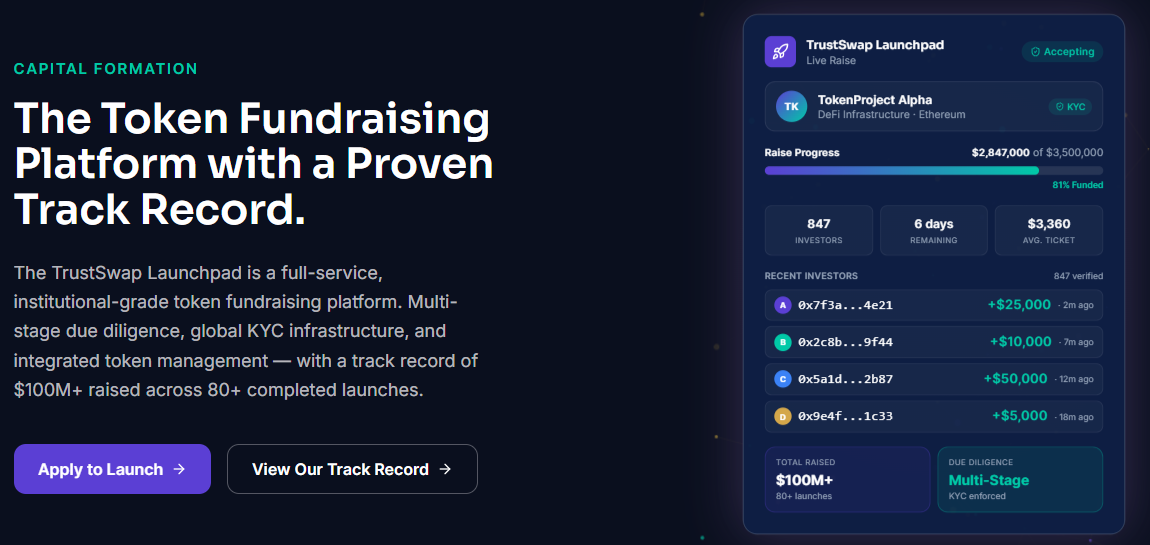
Source: TrustSwap
Fjord Foundry differs from fixed-price IDOs by using LBPs. Its model is designed to connect projects with backers while helping establish decentralized-exchange liquidity. Participants therefore encounter market-based price discovery rather than a conventional fixed subscription price.
| Platform | Main model | Notable 2026 information |
| Binance Launchpad | Exchange-based launches | Launchpool reached project No. 72 with Opinion |
| CoinList | Structured token sales | Introduced Passage in May 2026 |
| DAO Maker | Curated fundraising | Lists multiple current and historical projects |
| Polkastarter | Decentralized IDOs | Reported 17 IDOs in 2025 |
| Seedify | GameFi-focused launches | Specializes in gaming and Web3 projects |
| TrustSwap | Fundraising and token infrastructure | Reports over $100 million raised |
| Fjord Foundry | Liquidity Bootstrapping Pools | Uses market-based price discovery |
| Bybit Launchpad | Exchange-based subscriptions and lottery | Supports MNT and USDT participation |
| KuCoin Spotlight | Token sales and auctions | Used a sealed-bid Dutch auction for ZAMA |
| TrustPad | Multi-chain IDOs | Supports several blockchain networks |
Exchange Launchpads and IDO Platforms Continue to Evolve
Bybit Launchpad provides another exchange-based route, with its 3.1 system allowing eligible users to commit MNT for allocations or use USDT through a lottery mechanism. Bybit reported 18,916 participants for the MNT component of its XTER sale and 100,383 for its USDT lottery component.
KuCoin Spotlight has also moved beyond simple fixed-price subscriptions. In January 2026, it used a sealed-bid Dutch auction for Zama’s ZAMA token sale. Eligible users ultimately received allocations at the $0.05 clearing price, while unsuccessful bids were refunded.
TrustPad operates a decentralized multi-chain IDO model covering areas including DeFi, GameFi and AI. Its documentation states that users can stake or farm TPAD for access to IDOs, initial NFT offerings and other token-sale events. Eligibility varies by jurisdiction, and its rules exclude several jurisdictions, including the United States.
CoinList has expanded its activities through Passage, which it introduced in May 2026 as an access layer for on-chain capital markets. CoinList said it had helped launch networks including Filecoin, Solana, NEAR and Ondo since 2017, while users from more than 160 countries had purchased more than $1.2 billion in early-stage assets through the platform.
Key takeaways
- Crypto launchpads now use exchange sales, IDOs, auctions, staking, and liquidity bootstrapping mechanisms.
- Eligibility, KYC allocation rules, and geographic restrictions differ substantially between platforms.
- CoinList, Binance, Bybit, and other platforms continue developing distinct approaches to token distribution.
What Participants Should Compare Across Crypto Launchpads
Project selection is one of the clearest differences between platforms. DAO Maker focuses on curated products and services, while Polkastarter claims select project curation. TrustSwap also puts emphasis on due diligence and KYC within its fundraising process.
The access requirements may also play a vital role. For example, Bybit requires users to verify their identities and bans restricted jurisdictions from using its Launchpad. TrustPad also has access limitations related to the jurisdictions.
The launch mechanism can materially change how tokens are distributed. Exchange subscriptions, lotteries, and staking systems differ from the market-based pricing used by Fjord Foundry or the auction approach used by KuCoin Spotlight.
Crypto launchpads also do not eliminate the risks associated with individual projects. The supplied platform information shows that selection, screening or participation mechanisms do not establish that a token will perform successfully after launch.
Conclusion
The crypto launchpad market in August 2026 includes several distinct distribution models rather than one standardized approach. Binance and Bybit connect launches with centralized exchange infrastructure, while CoinList emphasizes structured offerings and Polkastarter and TrustPad continue their decentralized IDO models. Fjord Foundry uses LBPs and KuCoin Spotlight has employed auctions.
Frequently Asked Questions
What is a crypto launchpad?
A crypto launchpad connects early-stage blockchain startups with users and investors through features such as token sale, IDO, staking distribution, and liquidity pool.
What crypto launchpads employ an exchange-based system?
The launchpad services from Binance and Bybit offers exchange-based participation in the token launch process. KuCoin Spotlight functions in the exchange environment and has conducted token auctions.
What is Liquidity Bootstrapping Pool?
Liquidity Bootstrapping Pool is a liquidity protocol utilized by Fjord Foundry which uses dynamic weighting and market pricing to create liquidity and token price discovery.