
Free blockchain courses can be taken at Princeton University, The University at Buffalo, INSEAD, Alchemy University, Solana Foundation, Chainlink, Binance Academy, and several other institutions as of August 26, 2026.
The courses cover different subjects like the Bitcoin protocol, an introduction to blockchain, Ethereum programming, smart contracts, decentralized applications, and Solana programming.
Nevertheless, “free” may not necessarily imply that all course materials will be totally free. In some cases, free learning materials are offered, but the certification, graded tests, or other services cost money, while in other cases, all the material and exercises are provided without any cost.
The options also differ in terms of their technical level. Novices may begin their study with some basic blockchain resources, while programmers may opt for courses in Solidity, Ethereum, Solana, smart contracts, and programming.
Blockchain Courses Are Available Free of Charge
Currently, blockchain education goes beyond the basics of explaining Bitcoin. Current programs address distributed ledgers, cryptography, consensus mechanisms, smart contracts, decentralized applications, token standards, decentralized finance, and blockchain programming.
The edX blockchain catalog lists courses covering areas including distributed ledgers, smart contracts, and consensus mechanisms. The Linux Foundation also provides free educational resources, although some of its advanced Hyperledger training is paid.
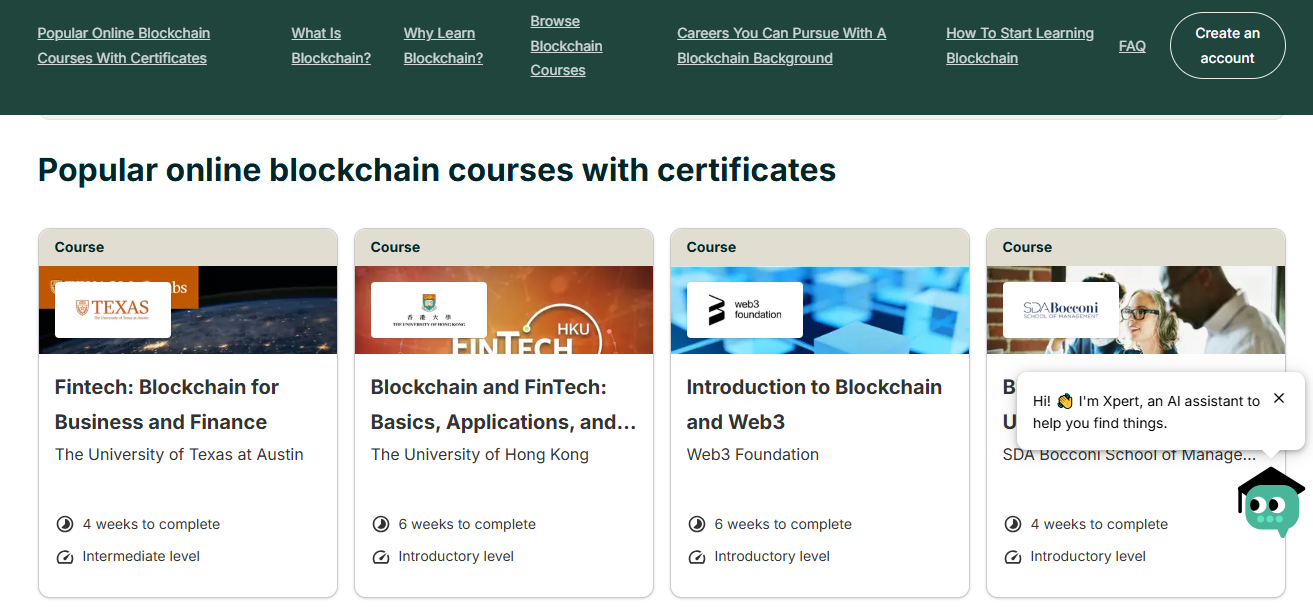
Source: edX blockchain catalog
The appropriate course, therefore, depends on what a learner wants to achieve. A newcomer may need a fundamentals program, while someone with programming experience may benefit more from a development-focused curriculum.
Princeton University Bitcoin Course
Princeton University’s Bitcoin and Cryptocurrency Technologies, taught by computer science professor Arvind Narayanan, is available through Coursera. Coursera currently states that all course features are available for free, although the course does not provide a certificate.
The 11-module program examines Bitcoin transactions, cryptographic protocols, mining, network protocols, security, anonymity, and alternative cryptocurrencies. It also considers what blockchain technology can and cannot decentralize.
Princeton also provides a companion textbook and programming assignments through its Bitcoin and Cryptocurrency Technologies project, giving the course a stronger technical focus.
University at Buffalo Blockchain Basics
The University at Buffalo’s Blockchain Basics course can be audited on Coursera at no tuition cost. Learners receive access to videos, readings, community discussion forums, and the ability to view assignments, while full assignment access and a verified certificate require payment.
The approximately 19-hour course starts with Bitcoin, then moves on to Ethereum. Its topics include peer-to-peer networks, distributed ledgers, hashing, cryptography, transactions, blocks, and mining.
The university’s broader four-course series progresses into smart contracts, decentralized applications, and blockchain platforms.
INSEAD Introduction to Blockchain Technologies
INSEAD’s Introduction to Blockchain Technologies is designed for beginners and requires no previous experience. Coursera currently lists five modules, 31 assignments and an estimated completion period of two weeks at 10 hours per week.
The curriculum covers blockchain architecture, Bitcoin, cryptography, decentralized trust, smart contracts, digital assets, governance, security and regulatory considerations.
Coursera identifies the course as part of a paid specialization and offers financial aid options, so learners should check the current access terms before assuming graded components and certificates are free.
Developer-Focused Free Blockchain Courses
For learners who want practical programming experience, several free blockchain courses place greater emphasis on development.
| Course | Main Focus | Access Details |
| Princeton Bitcoin and Cryptocurrency Technologies | Bitcoin and cryptography | Free course access; no certificate |
| Buffalo Blockchain Basics | Bitcoin and Ethereum fundamentals | Free audit; some features paid |
| Alchemy Ethereum Bootcamp | Ethereum and Solidity | Free |
| Solana developer courses | Solana programming | Free developer resources |
| Chainlink Smart Contract Developer Bootcamp | Smart contracts and Solidity | Free |
| Binance Academy Beginner Track | Blockchain and cryptocurrency basics | Free |
Blockchain Tracking and cryptocurrency basics Free
Alchemy University’s Introduction to Blockchain comprises 43 lessons and is designed for beginners with no prerequisites. The curriculum covers Web1, Web2, and Web3 before moving into tokens, smart contracts, decentralized finance and other blockchain applications.
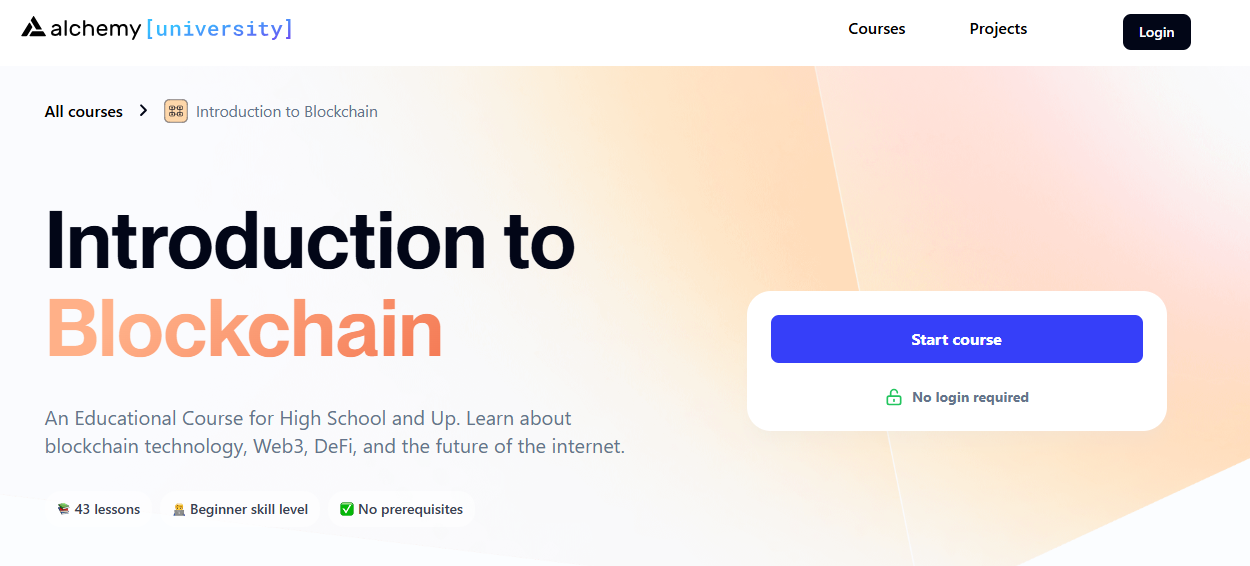
Source: Alchemy University
For more experienced developers, Alchemy’s Ethereum Bootcamp contains more than 90 lessons covering blockchain cryptography, storage, Ethereum’s state machine, smart contracts, Solidity, and governance. It includes coding challenges, written material, videos, projects, and a final capstone project. JavaScript knowledge is required.
The Solana Foundation also provides a free developer course library covering blockchain interaction, token and NFT creation, Anchor-based development, and development without Anchor. Its materials also address security, mobile development, state compression, and other specialized subjects.
Chainlink’s free Smart Contract Developer Bootcamp provides training in Solidity and smart-contract development. Its material includes ERC-20 tokens, staking applications, and cross-chain token deployment.
Free Blockchain Courses Also Offer Broad Introductory Learning
Binance Academy provides free blockchain and cryptocurrency education through its Beginner Track and additional intermediate material. The platform covers blockchain, cryptocurrencies, decentralized applications, DeFi, and NFTs.
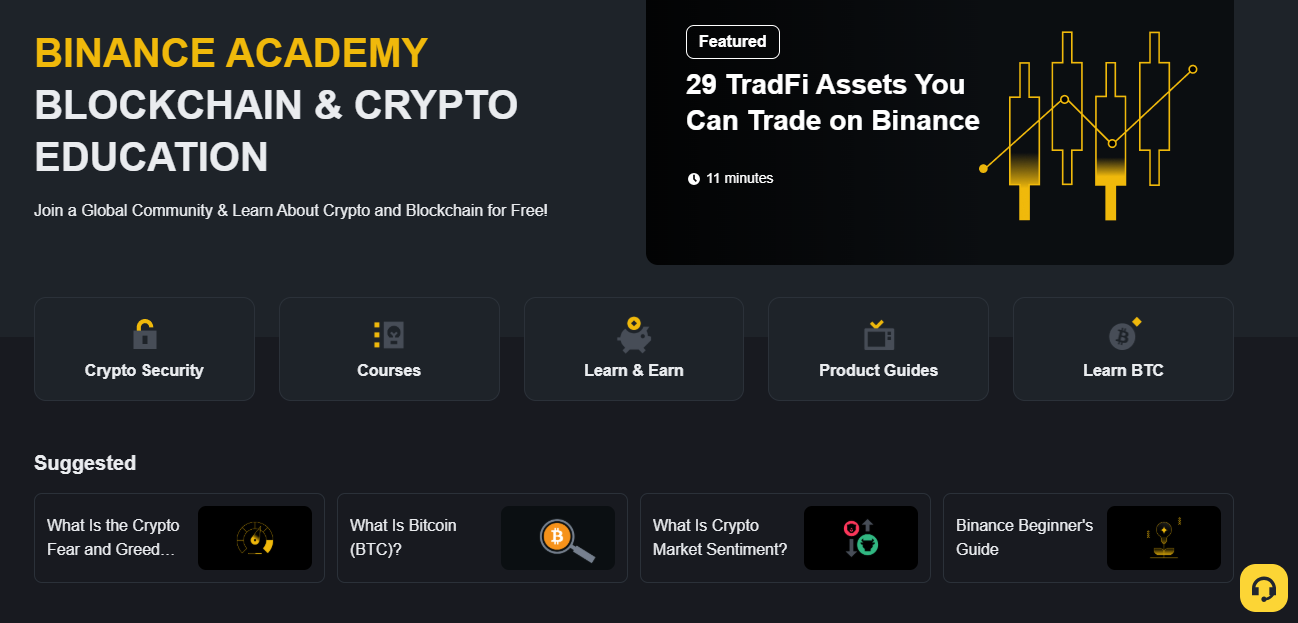
Source: Binance Academy
The organization’s blockchain tutorial was last modified on June 25, 2026, and touches upon issues like consensus algorithms, blockchain structure, layer two scaling, and tokenization.
CryptoZombies offers an alternative in the form of programming exercises and games. The learning materials of CryptoZombies are primarily based around Ethereum and Solidity. Instead of taking lectures, students advance their knowledge by coding via interactive tutorials.
Hyperledger project from The Linux Foundation is another option available to learners interested in enterprise blockchain. This learning ecosystem is based on enterprise blockchain and decentralized identity; however, some of the more sophisticated courses, such as Hyperledger Fabric: Design, Develop and Deploy, are paid.
Conclusion
You can take free blockchain courses in 2026 in several ways, including the Bitcoin Course from Princeton University or the Blockchain Basics and Ethereum, Solana and Chainlink Courses available via Alchemy.
Blockchain beginners need to evaluate the access, technical needs, and outputs of each program rather than considering all free programs the same. For students who want to build skills, there are programs that provide opportunities to code as part of their course content.
FAQs
Are Princeton University’s Bitcoin courses free?
Princeton University’s Bitcoin and Cryptocurrency Technologies is offered on Coursera; while its content is free, it doesn’t offer a certificate.
Is Blockchain Basics free?
Blockchain Basics from the University of Buffalo is available for auditing free of charge, while access to assignments and certificates requires payment.
What free courses teach blockchain development?
Alchemy University, Solana Foundation, Chainlink and Crypto Zombies offer free courses for developers on Ethereum and Solidity, smart contract technology, and Solana development.
Do free blockchain courses come with certificates?
Not necessarily. Princeton’s course does not provide a certificate, while Buffalo charges for its verified certificate and full graded access.