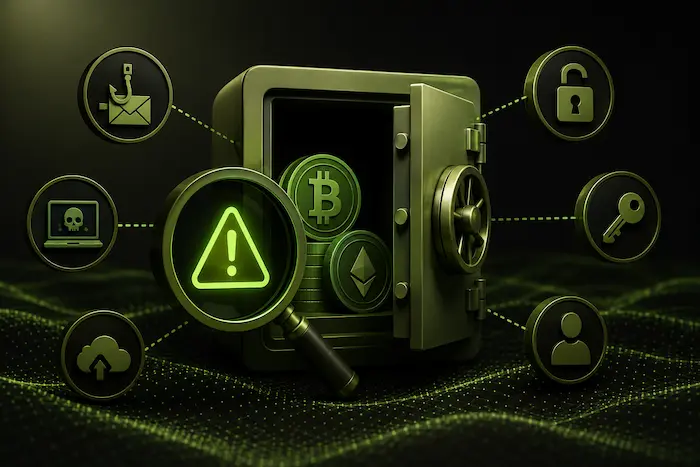
Security measures for cryptocurrencies have become more relevant as hackers keep targeting wallets, exchanges, and consumers through phishing and social engineering attacks.
In its 2025 annual report, the FBI indicated that there were reported losses of $7.228 billion from 61,559 complaints in investment fraud cases related to cryptocurrencies, which is an increase of 25% from the losses in 2024.
In the same report, the FBI also reported losses amounting to $1.4 billion from recovery scams, where victims who had lost their money to the crime were offered solutions. These numbers reflect a number of security measures that involve recovery phrases, account authentication, transaction approval, and wallets.
Ledger’s Crypto Security Tips Begin with Seed Phrase Security
Seed phrases, otherwise known as secret recovery phrases, can help one regain access to their self-custody wallets. According to Ledger’s crypto security tips, recovery phrases must never be shared or typed on phones or other internet-connected devices.
The guidance also warns against photographing recovery phrases or storing them in cloud services. Physical storage can avoid creating digital copies, although backups remain exposed to physical risks such as theft, fire and water damage.
Users should never provide recovery phrases to people claiming to represent wallet providers, exchanges, or customer-support teams. The supplied guidance states that legitimate support personnel do not require a recovery phrase to access a user’s wallet.
Strong Authentication Adds Protection to Exchange Accounts
Hackers can compromise exchange accounts by stealing login credentials. CISA recommends multifactor authentication and describes phishing-resistant MFA as the most secure approach.
According to its guidelines, SMS authentication may be subject to SIM swapping, whereas security keys based on FIDO technology and passkeys are more resistant to phishing. Authenticator apps also exist as an alternative, but authentication codes remain vulnerable to phishing attempts.
The email associated with the exchange should be secured as well since it may be used for password resets and account recovery.
Two related security recommendations include:
- Employ distinct passwords for transactions and emails.
- Employ a password manager and passwords of at least 16 characters, as recommended by CISA for its 2025 cybersecurity strategy.
| Security recommendation | Recommendations reported |
| Seed phrase | Keep it offline and never disclose it to anyone |
| MFA | Prefer phishing-resistant methods |
| Passwords | Use long and unique credentials |
| Token approvals | Review and limit permissions |
| Withdrawals | Use allowlisting where possible |
Validate Links and Wallet Applications
Phishing attacks remain among the most common attack types used to obtain login credentials or get authorizations for financial operations. According to the data collected by the FBI, in 2025, the amount of money stolen as a result of investments in cryptocurrencies reached $7.228 billion, with 61,559 phishing attacks.
CISA recommends verifying sender information before opening any links and attachments. Crypto users should independently verify website addresses and wallet applications instead of relying on links received through social media, email or messaging platforms.
Fake support representatives can also request seed phrases, private keys or remote computer access. Such requests are identified in the supplied security guidance as warning signs.
Review Smart-Contract Approvals
Hardware wallets can protect private keys from several remote threats, but they cannot prevent users from approving malicious smart contracts.
MetaMask explains that token approvals allow decentralized applications to access and move specified tokens. Unlimited approvals can therefore create exposure if a malicious contract or compromised application uses the permission to move approved assets.
Users should review the contract, token, amount, and transaction details before signing. Where supported, limited approvals can reduce the amount of assets exposed to a permission.
MetaMask has also mentioned that disconnecting one’s wallet from a decentralized application is not necessarily going to deny the permissions given on the tokens used by the application previously.
Different Wallets for Different Purposes
Wallet compartmentalization is yet another method mentioned within the provided information regarding protection. A long-term wallet may exist separately from an operational wallet designed for decentralized finance and other purposes.
This method will limit the amount of assets that could become affected by a compromised application or transaction. This method won’t protect against theft from a compromised wallet, but it could isolate more valuable assets from normal transactions. June 2026 guidance from Ledger also says that compromising a recovery phrase compromises all accounts secured by that phrase.
Exchange Allowlisting and Software Updates
Withdrawal allowlisting has been explained in Coinbase’s documentation as the function where only the approved addresses may send coins from the account.
For the normal configuration, two-factor authentication is used, and there is always a 48-hour period required for the address to start sending coins.
Another form of security measure identified by CISA includes software updates. The update can help deal with vulnerabilities in the operating system, browsers, wallet applications, among others. It is advisable to obtain your wallet software from trusted sources.
A Large-Scale Theft Reveals the Extent of Crypto Security Threats
According to Reuters, $1.5 billion worth of Ether was stolen from Bybit in February 2025, with this being the biggest crypto theft ever recorded.
The supplied information also notes that cryptocurrency firms were preparing for longer-term risks associated with quantum computing and potential attacks against cryptographic systems, although those risks remain a developing area.
FAQs
What is the most important crypto security measure?
Keeping the seed phrase offline and never sharing it is a central self-custody security measure.
Could a hardware wallet guard against all crypto thefts?
No. As per the provided Ledger instructions, hardware wallets will not be able to stop users from signing smart contracts.
Is revoking token approval necessary?
Yes. MetaMask says that the token approvals can still be active even if you are logged out of the DApp.