

The debate about how blockchain networks should manage growing volumes of transactions was the reason for one of the biggest rifts in the cryptocurrency world. Developers and miners had disputes about how to make Bitcoin more scalable, which became the reason for creating a separate blockchain network with its own technical focus.
Bitcoin Cash (BCH) is a hard fork that was launched in August 2017, which maintains most of the features of Bitcoin while using large blocks to allow for more transactions on-chain.
While sharing a number of attributes such as proof of work consensus, constant coin supply, and the block production process, Bitcoin Cash takes its own development route via protocol updates and modifications aimed at increasing the transaction load on-chain.
Why Bitcoin Cash Was Created
Bitcoin Cash was established due to conflicts in the Bitcoin community as far as the means of solving the problem of congestion were concerned.
The growing use of the cryptocurrency led to long periods of confirmation and the increase of network charges, which sparked debates over whether the blockchain would increase the size of blocks or employ other ways to scale.
As the protocol amendments for Bitcoin require wide consent from all parties of the network, an agreement was not achieved. It is due to this that developers, miners, entrepreneurs, and investors who advocated the expansion of blocks gave rise to the creation of Bitcoin Cash via a hard fork in August 2017.
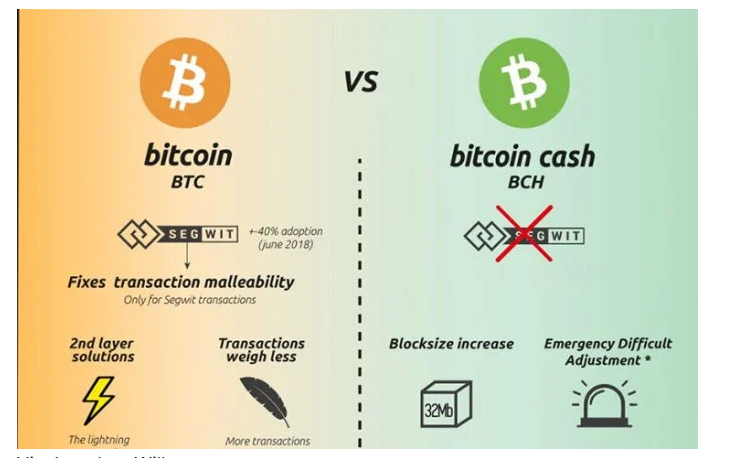
Source: CryptoBriefing
The supporters of the forked blockchain believed that the increase in the block size would help the system process more transactions while still retaining the peer-to-peer payment system, as envisioned during the creation of the Bitcoin system.
Among the people who supported the fork were figures such as Bitmain co-founder Jihan Wu and Bitcoin.com CEO Roger Ver.
Bitcoin Cash and SegWit Technology
After the Bitcoin Cash hard fork, Bitcoin adopted the SegWit technology, which was developed to increase the transaction capacity of the network.
Bitcoin Cash, however, opted for increasing the size of the blocks instead of going for the SegWit option. The BCH developers argued that an increased block size was a better solution to supporting higher transaction numbers on the main blockchain. As such, the two blockchains solved the issue of scalability using different mechanisms.
Technical Characteristics of Bitcoin Cash
Bitcoin Cash uses the same code as Bitcoin, and, as such, it has some common traits.
The main technical characteristics consist of:
- Proof-of-Work algorithm with miners to verify transactions.
- The maximum supply of coins is fixed at 21 million BCH.
- A desired block generation time of around 10 minutes.
- Halving of rewards for every 210,000 blocks, where the existing reward equals 3.125 BCH after the 2024 halving event.
The main feature of this network is its larger block capacity. The initial block size was increased from 1 MB to 8 MB, later increasing to 32 MB in 2018.
Adaptive Block Limit Algorithm was launched by Bitcoin Cash in 2024, which would allow the block size to be adapted based on network activity while remaining at least 32 MB.
Network Upgrades of Bitcoin Cash
Several upgrades have been made to the protocol of Bitcoin Cash since the launch of the network.
These include:
- Schnorr Signatures, developed in 2019 as an improvement to the scalability and privacy features when compared with the ECDSA signature algorithm utilized by Bitcoin.
- CashTokens, which have allowed for the creation of tokens.
- Layla Network Upgrade, set for May 2026, bringing with it the introduction of bounded loops and reusable functions.
Bitcoin Cash Mining Difficulty Adjustments Are Also Different from the Bitcoin Ones. The Bitcoin cryptocurrency performs mining difficulty adjustments every 2,016 blocks, whereas for Bitcoin Cash, difficulty is recalculated each time after the block.
Bitcoin Cash vs. Bitcoin
Both cryptocurrencies were created on the basis of one blockchain; however, their further development paths were different.
Bitcoin Cash emphasizes increasing the number of transactions through expansion of block size and implementation of protocol changes directly to the blockchain. Bitcoin has managed to keep its block sizes relatively small and work on layer 2 scaling solutions such as the Lightning Network.
Use of large blocks enables Bitcoin Cash to process more transactions per block. But at the same time, it requires more storage and bandwidth for the network participants that run full nodes. Bitcoin’s approach emphasizes minimizing those hardware requirements while relying on secondary scaling solutions.
Current Uses of Bitcoin Cash
Bitcoin Cash continues to be used for several blockchain-based payment activities.
Its reported use cases include:
- Merchant payments through services such as Shopify and TravelByBit.
- Transfers across the border using the BCH blockchain.
- Storing using hardware wallet, software wallet, and web wallet.
Since Bitcoin and Bitcoin Cash exist on separate blockchains, transferring funds into the wrong network will cause permanent loss of the funds.
Conclusion
Bitcoin Cash is a new blockchain developed due to disputes over the Bitcoin scalability approach.
The development of Bitcoin Cash since its launch in 2017 has been focused on increasing transaction capabilities on the chain, but it has not stopped working on other upgrades of its protocol, including Schnorr Signatures, Cash Tokens, and the Layla upgrade.
FAQs
What is Bitcoin Cash?
Bitcoin Cash is a digital currency that was introduced using a Bitcoin hard fork in August 2017 with an aim of enabling large transaction capacity.
How is Bitcoin Cash different from Bitcoin?
Bitcoin Cash employs larger blocks as well as mining difficulty adjustments after every block. Bitcoin, on the other hand, employs small blocks and Layer 2 scaling solutions.
What is the maximum supply of Bitcoin Cash?
The maximum Bitcoin Cash supply is set to be 21 million BCH, just like Bitcoin.