

- The Ethereum Governance Debate started growing after a new fiction book by Buterin was revealed.
- Lubin approved the idea and compared it to research in governance and coordination.
- The book discusses the voting system of DAOs along with AI.
Ethereum Governance Debate Intensifies as Ethereum co-founder Vitalik Buterin moves forward with a science fiction novel centered on decentralized governance, a project that has sparked discussion across the Ethereum community amid market pressure and organizational changes.
The literary project, announced through the decentralized social protocol Farcaster, comes as Ethereum faces a significant price decline and the Ethereum Foundation adjusts to the departure of nine core members.
While some community participants have questioned the timing of the initiative, Ethereum co-founder and Consensus Chief Executive Officer Joseph Lubin has publicly defended the project, describing it as an extension of Buterin’s long-standing work exploring governance, coordination, and decentralized systems.
Vitalik Buterin Uses Fiction to Explore Decentralized Governance Issues
Buterin stated that he has begun working on writing a novel that delves into decentralized governance tools in the context of a fictitious nation.
From the details provided regarding this endeavour, it is clear that the novel focuses on governance frameworks that make use of principles such as quadratic voting and AI-enabled decision-making.
The co-creator of Ethereum has already uploaded the first two chapters of this novel on his personal website.
The research also considers constraints that accompany Decentralized Autonomous Organizations (DAO). Such constraints involve governance issues and financial inequalities that may arise in decentralized environments.
The announcement immediately caught public attention within the cryptocurrency industry, creating various responses from Ethereum proponents.
Ethereum Governance Controversy Gains Momentum amid Larger Trends
The discussion around the novel took place during the time when some other events took place in Ethereum.
Moreover, the cryptocurrency has witnessed a major drop in the market, which made the management of the organization a subject of interest. At the same time, the Ethereum Foundation has undergone internal changes following the departure of nine core members.
Against that backdrop, some community members publicly criticized Buterin’s decision to dedicate time to a literary project. The debate on the social media forums revolved around whether the proposal was in line with the present concerns of the Ethereum ecosystem.
While this criticism garnered much attention in the online forum, the advocates for the proposal contended that governance research and communication were equally important for Ethereum’s future development.
Joseph Lubin Publicly Defends the Project
Joseph Lubin emerged as one of the most prominent voices supporting Buterin’s initiative.
In public comments, Lubin described Buterin as an “enormously effective communicator” and stated that he remains the most important contributor and steward of the Ethereum ecosystem.
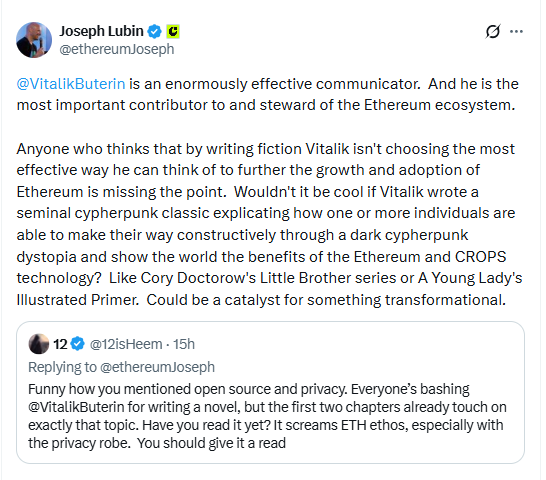
Source: Joseph Lubin
Lubin argued that fiction can serve as an effective format for examining complex governance questions. According to his statements, the novel is an attempt to deal with issues which relate directly to decentralized systems and digital coordination.
Lubin also refuted the notion that writing a novel goes against any of his activities related to Ethereum. On the contrary, Lubin said that one should see the project as yet another way to facilitate discussion about governance and coordination in blockchain systems.
This statement brought much attention to the Ethereum Governance Debate because of the conflicting opinions on intellectual activities in blockchain development.
Governance, Privacy, and Coordination as Themes
The information available on the novel suggests that it delves into themes outside of the usual scope of science fiction stories.
In this novel, various governance frameworks that can coordinate decisions among many people have been explored. Some of the governance frameworks that have been used in this story are artificial intelligence-enabled frameworks and quadratic voting.
Lubin also associated the project with issues regarding privacy, cypherpunk and digital coordination.
According to his statements, future economic systems may increasingly incorporate forms of collective coordination that require neutral digital infrastructure. He connected those ideas to Ethereum’s broader mission and the governance questions explored in the novel.
The project therefore serves as a fictional platform for examining governance concepts that have been discussed within blockchain communities for years.
Ethereum Governance Issues: The Focus on the Long Term
The debate on Ethereum Governance issues triggered by this novel proves that there is still great concern about the models of governance and organization of decentralized networks.
The publication of the first two chapters has already brought the discussion away from the novel itself and into larger questions concerning decision-making, decentralized organizations, and digital coordination mechanisms.